
The Missing Piece to Better Balance Most People Overlook
Summary:
Discover effective balance improvement exercises that combine functional fitness, mobility exercises, and proprioception exercises to help you move with strength, confidence, and control.
Introduction
Balance is more than just standing still — it’s a skill your body learns and refines through movement. Whether you’re improving athletic performance, preventing falls, or simply trying to feel more confident walking down the street, targeted exercises can make a life-changing difference.
In this blog, we’ll explore how functional fitness and proprioception exercises work together to enhance balance and help your body move safely and efficiently in everyday situations.
What Is Functional Fitness and Why It Matters for Balance
Functional fitness refers to exercises that mirror real-world movements — the kind of patterns you use when you walk, lift groceries, step up a stair, or reach overhead.
Unlike isolated movements (like curling a dumbbell), functional fitness trains multiple muscle groups and coordinate them together. This synergy is key for balance because your body must constantly adjust when:
You change direction
You transition from sitting to standing
You encounter uneven ground
Functional fitness improves balance because it trains your body to react dynamically — not just hold still.
Mobility Exercises: Create Freedom of Movement
Mobility exercises target your joints and connective tissues to help you move through full ranges of motion more easily.
Why is this important for balance?
Because when your hips, ankles, and spine are stiff, your body must compensate — often in less stable ways.
Try these mobility techniques:
• Ankle circles — improves ankle motion
• Hip openers — enhances stride stability
• Spinal twists — supports posture and balance control
Each of these helps your body adjust to changes in terrain and shift weight smoothly.
Proprioception Exercises: Train Your Body to Sense Itself
Proprioception is your body’s ability to sense where it is in space — the unconscious “feel” that lets you walk without checking your feet.
When proprioception is strong, your nervous system reacts faster, and you make subtle adjustments to maintain balance.
Common proprioception exercises include:
Single-leg stands
Balance board exercises
Uneven surface work
Eyes-closed stability challenges
These exercises help your body understand its position and make micro-corrections before a loss of balance becomes a fall.
Putting It All Together: A Simple Routine
Start with gentle mobility work to warm up, then layer in functional fitness patterns, and wrap up with proprioception challenges.
Example routine:
1) Functional Step-Ups — 12 reps each leg
2) Single-Leg Balance — 30 seconds each side
3) Balance Reach Challenge — 10 reps each side
This sequence improves joint mobility, builds strength through functional movement patterns, and trains your body to sense and react to changes.
Explore Balance Exercises on Pinterest
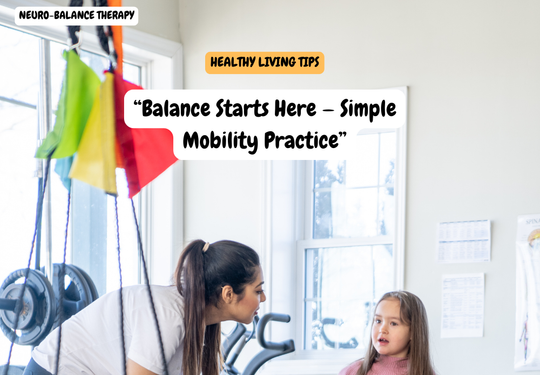
Below is a Pinterest Pin that illustrates a gentle routine full of balance, mobility, and proprioception movements that complement everything you’ve just read.
📌 Tap this Pin to save this routine and revisit it anytime on your Pinterest boards!
Move Forward with Confidence
Improving balance isn’t about perfect performance — it’s about consistent progress.
By combining:
✅ Functional fitness
✅ Mobility exercises
✅ Proprioception exercises
you help your body become more resilient, adaptable, and confident in everyday movement.